
Spectacle lenses in Worcester, chosen around your prescription and everyday needs
Choosing spectacle lenses is about more than matching a prescription to a frame. At our Worcester practice, the right lens should give you clear, comfortable vision for the way you live, whether you drive, read, use screens, work at different distances, or want one pair of glasses to do several jobs. Following your eye examination, we take time to understand your eyes, your routine and any previous problems, then explain the lens choices in plain English.
Our aim is simple: help you achieve the best possible vision without pressure. Sometimes that means recommending new lenses. Sometimes it means saying your current glasses are still serving you well.
Practical, Honest Advice
If your prescription has changed very little, we will tell you. A small change may still make a worthwhile difference for some people, particularly for driving, reading or detailed work, but it does not automatically mean you need new glasses. We will explain what difference you are likely to notice and leave the decision with you.
There is no hard sell. We will explain the options clearly and leave the decision with you.
Struggled With Glasses Before?
We often help patients whose glasses have never felt quite right or whose problems have not been resolved elsewhere. Sometimes the answer is a different lens design, more accurate measurements, a better frame fit or simply taking more time to understand how the glasses are being used. As an independent practice, we have access to a wide range of lens suppliers and solutions, so we can explore different options rather than being limited to one route.
Visual Lens Types
Different lens types are designed around different viewing distances and visual tasks. We will help you choose the option that best matches your prescription, work, hobbies and everyday routine.
| Lens type | Best suited to | Main advantage | Main limitation |
|---|---|---|---|
| Single vision | One main viewing distance: distance, reading, screen or specialist task | Simple, wide clear field for the prescribed distance | Does not cover several distances in one lens |
| Bifocal | Distance and near vision with a clearly defined reading area | Reliable near zone with a clear separation between powers | Visible segment and no gradual intermediate corridor |
| Varifocal | Distance, intermediate and near vision in one pair | One lens for several everyday distances without a visible line | Side areas are less clear and good measurements/fitting are important |
| Occupational / computer | Desk work, screens, workshops and other close-to-intermediate tasks | Wider comfortable working zones than general varifocals at close/intermediate distances | Usually unsuitable for driving or general distance use |
Whichever visual lens type you need, there may also be choices in lens material, thickness and coating. Frame size, shape and fit can influence the finished thickness and appearance, particularly with stronger prescriptions, so we consider the frame and lenses together. Most lens types can also be supplied as prescription sunglasses or with Transitions light-reactive technology where suitable.
Single Vision Lenses
Single vision lenses correct one viewing distance. They may be prescribed for distance, reading, music, hobbies or screen work, depending on how you need to use your vision.
Bifocal Lenses
Bifocals have two distinct zones, usually distance at the top and reading at the bottom. Some patients like the clear separation and reliable reading area. They can suit people who do not want a progressive corridor, although the visible segment and jump between distances are not ideal for everyone. We will talk through the practical pros and cons.
Varifocal Lenses
Varifocal lenses provide distance, intermediate, and near vision without a visible line. Modern designs can be very comfortable, but the best result depends on accurate measurements, suitable frame choice, realistic advice, and careful fitting. Different designs suit different habits: a keen driver, an office worker, and someone who reads for long periods may need different priorities.
If you have struggled with varifocals before, it does not always mean varifocals are wrong for you. The design, measurements, prescription, frame fit, or expectations may not have matched your needs. We will review these details carefully.
Occupational and Computer Lenses
Occupational lenses are designed around specific working distances, such as a desk, till, workshop, consulting room, or multiple screens. They can give a wider comfortable area than general varifocals for close and intermediate tasks, but they are not usually suitable for driving. If you spend many hours at a screen, bring details of your working distance to your appointment.
Children’s Lenses
Children use their eyes and glasses differently from adults, so lens design, impact resistance, fit and coating choice all matter. We offer specialist options including Eyezen Kids and Crizal Kids, with fuller information on our children’s eyecare page.
Lens Materials, Thickness and Optical Quality
The same prescription can look and feel quite different depending on the lens material, refractive index, frame size and frame shape. A higher refractive index can make a lens thinner, but each material has its own balance of optical quality, strength, weight, tintability, photochromic performance and cost. Higher-index lenses are also progressively more expensive, so the thinnest material is not automatically the best choice.
| Material / index | Optical character | Strength & rimless use | Tinting / sunglasses | Transitions / photochromic | Durability | Relative cost |
|---|---|---|---|---|---|---|
| CR-39 / 1.50 | Excellent optical clarity with low chromatic distortion; thicker in stronger prescriptions | Less impact resistant than polycarbonate or many 1.60 materials; not usually first choice for drilled rimless work | Usually the easiest material to tint deeply and evenly; very good for conventional prescription sunglasses | Photochromic performance can be very good, depending on the specific product | Good everyday durability with a suitable hard coating, but lower impact resistance | £ |
| Polycarbonate / about 1.59 | Thin and light, but generally more colour fringing away from the optical centre than CR-39 or many 1.60 materials | Very high impact resistance; useful for children, sport, safety applications and some rimless designs | Can be tinted, but colour depth and consistency may be more limited than CR-39 | Available in photochromic options; final darkness and fade-back depend on the product and conditions | Excellent impact strength; benefits from a good scratch-resistant coating | ££ |
| 1.60 high-index | Good balance of thinness and optical quality for moderate prescriptions | Often tougher than standard 1.50 and commonly suitable for rimless glazing, depending on the exact lens material and design | Generally tints well, although very dark cosmetic tints may vary by product | Widely available in modern photochromic ranges; performance varies by brand, colour and temperature | Good everyday strength and a versatile choice for many frames | ££ |
| 1.67 high-index | Noticeably thinner for stronger prescriptions, with more potential peripheral colour fringing than 1.50 or 1.60 | Strong enough for many conventional frames; suitability for drilled rimless frames depends on the exact product and prescription | Can be tinted, but achieving very dark or perfectly matched colours may be more restrictive than lower-index materials | Available in photochromic options, but maximum darkness can differ from lower-index versions | Good durability when correctly edged and coated | £££ |
| 1.74 high-index | One of the thinnest commonly available plastic materials; best reserved for prescriptions where the thickness saving is worthwhile | More brittle than some lower-index materials, so frame choice and glazing method matter; not automatically the best option for rimless frames | Tinting choices are usually more limited and deep cosmetic tints may not be ideal | Photochromic availability and performance depend on the specific manufacturer; choice may be narrower than in lower indexes | Requires careful handling and a good coating; chosen mainly for thinness rather than impact strength | ££££ |
These are general characteristics rather than fixed rules. Exact performance varies between manufacturers, lens designs and coatings. Photochromic darkness and fade-back also vary with temperature, ultraviolet exposure, lens material and colour.
CR-39 (1.50 index)
CR-39 remains an excellent optical material for lower prescriptions. It gives very good clarity and is especially useful where a deep conventional sunglass tint is wanted. Its main disadvantages are thickness in stronger prescriptions and lower impact resistance compared with tougher materials.
Polycarbonate (about 1.59 index)
Polycarbonate combines a refractive index of about 1.59 with very high impact resistance and low weight. That makes it particularly useful for children, sport, safety-related applications and some rimless frames. The trade-off is optical: it generally produces more colour fringing away from the optical centre than CR-39 or many 1.60 lenses, so it is not automatically the best material simply because it is strong.
1.60 high-index
A 1.60 lens is often the most versatile step up from standard material. It can reduce thickness without the larger jump in cost associated with higher indexes, and many 1.60 materials combine good optical performance with useful toughness for modern frame designs.
1.67 high-index
A 1.67 lens can give a worthwhile reduction in thickness for stronger prescriptions. It costs more than 1.60 and can show more peripheral colour fringing, so the benefit needs to justify the extra expense for the individual prescription and frame.
1.74 high-index
A 1.74 lens is chosen mainly where reducing thickness matters enough to justify the highest material cost. It is not automatically the strongest or optically best material, and the improvement over 1.67 can be modest in some prescriptions. Frame choice is particularly important.
Frame choice can make a major difference
Lens thickness is influenced not only by the material but also by the size, shape and fit of the frame. With short-sighted prescriptions, a smaller, well-centred frame can substantially reduce edge thickness. With long-sighted prescriptions, the frame shape and lens diameter can also affect centre thickness and magnification.
A well-suited frame can therefore reduce or sometimes remove the need to pay for the highest-index material. We will look at the prescription and frame together, show you where spending more is likely to make a visible difference, and say when a more modest lens material should give an equally satisfactory result.
Lens Coatings
Lens coatings can make everyday wear easier. A good anti-reflection coating can reduce distracting reflections, improve the appearance of the lenses, and make cleaning simpler. Crizal options may offer benefits such as resistance to scratches, smudges, dust, water and reflections, depending on the exact coating chosen.
At the premium end of the range, Crizal Natural Look is Essilor’s replacement for the now-discontinued Sapphire HR. It keeps the premium protection and advanced scratch resistance of Sapphire HR, while its Advanced Aesthetic Technology is designed to make residual reflections and their colour much less noticeable. The result is a clearer, more natural-looking lens on the face.
Crizal Natural Look also retains the two-year scratch guarantee that was an important benefit of Sapphire HR. As with any coating, the guarantee is subject to Essilor’s terms and does not make the lens indestructible, so suitable cleaning and storage remain important.
Essilor Lens Expertise

Actons Opticians is recognised by Essilor as an Essilor Expert practice. This reflects our experience advising on and fitting Essilor lenses, including premium Varilux varifocals, Transitions light-reactive lenses and Crizal lens coatings. The best lens is not simply the most expensive one: it is the design that best matches your prescription, visual habits, frame and expectations.
Accurate measurements and careful fitting are especially important with premium lenses. We consider how you use your vision at distance, on screens and at reading range, as well as the way your chosen frame sits on your face. We then explain which features are likely to make a noticeable difference for you.
Varilux XR series varifocal lenses
Varilux XR series is Essilor’s premium varifocal design. Essilor describes it as its first eye-responsive varifocal lens, using prescription information and visual-behaviour data to help optimise how the two lenses work together as your eyes move between distance, intermediate and near tasks.

Essilor reports that nine out of ten wearers in its consumer study perceived instant sharpness at all distances, even while moving, and felt adapted by the first day. These are manufacturer study results and individual experiences vary, so we will always base our recommendation on your own prescription, previous varifocal experience and everyday visual needs.
Varilux XR may be worth considering if you move frequently between distance, screens and reading, want a premium varifocal with a generous usable field of vision, or have previously found progressive lenses restrictive. No varifocal design is ideal for everyone, and careful measurement and fitting remain essential.
Eyezen enhanced single-vision lenses
Eyezen lenses go beyond a basic single-vision design by taking account of how the eyes are used at different distances throughout the day. Eyezen Start optimises the lens across distance and near viewing, helping provide clearer, more comfortable vision away from the central viewing point. It can be a good everyday upgrade for people who want a more advanced single-vision lens.
Eyezen Boost adds a small amount of extra support in the lower part of the lens to reduce the focusing effort involved in prolonged close work and digital-device use. It is designed for single-vision wearers with visually demanding, screen-heavy lifestyles who are not yet ready for varifocals. We will advise whether Eyezen Start, Eyezen Boost or a conventional single-vision lens is the most appropriate choice for your prescription and symptoms.
Transitions GEN S light-reactive lenses
Transitions GEN S lenses are clear indoors and darken automatically outdoors in response to ultraviolet light. They can be combined with many single-vision and varifocal prescriptions, reducing the need to change constantly between clear glasses and sunglasses.
The latest GEN S technology is a clear improvement on many older photochromic lenses. Patients who tried an earlier generation, or a less advanced light-reactive product from another manufacturer, may have found that the lenses changed too slowly, stayed too dark indoors or did not provide the colour they expected. GEN S is designed to darken more quickly, return to clear faster and offer a more attractive choice of colours.
Transitions states that GEN S lenses darken in seconds outdoors and fade back in less than two minutes under its test conditions. They are available in eight colours. Performance varies with lens material, colour, temperature and ultraviolet exposure, so we will explain what to expect in everyday use.
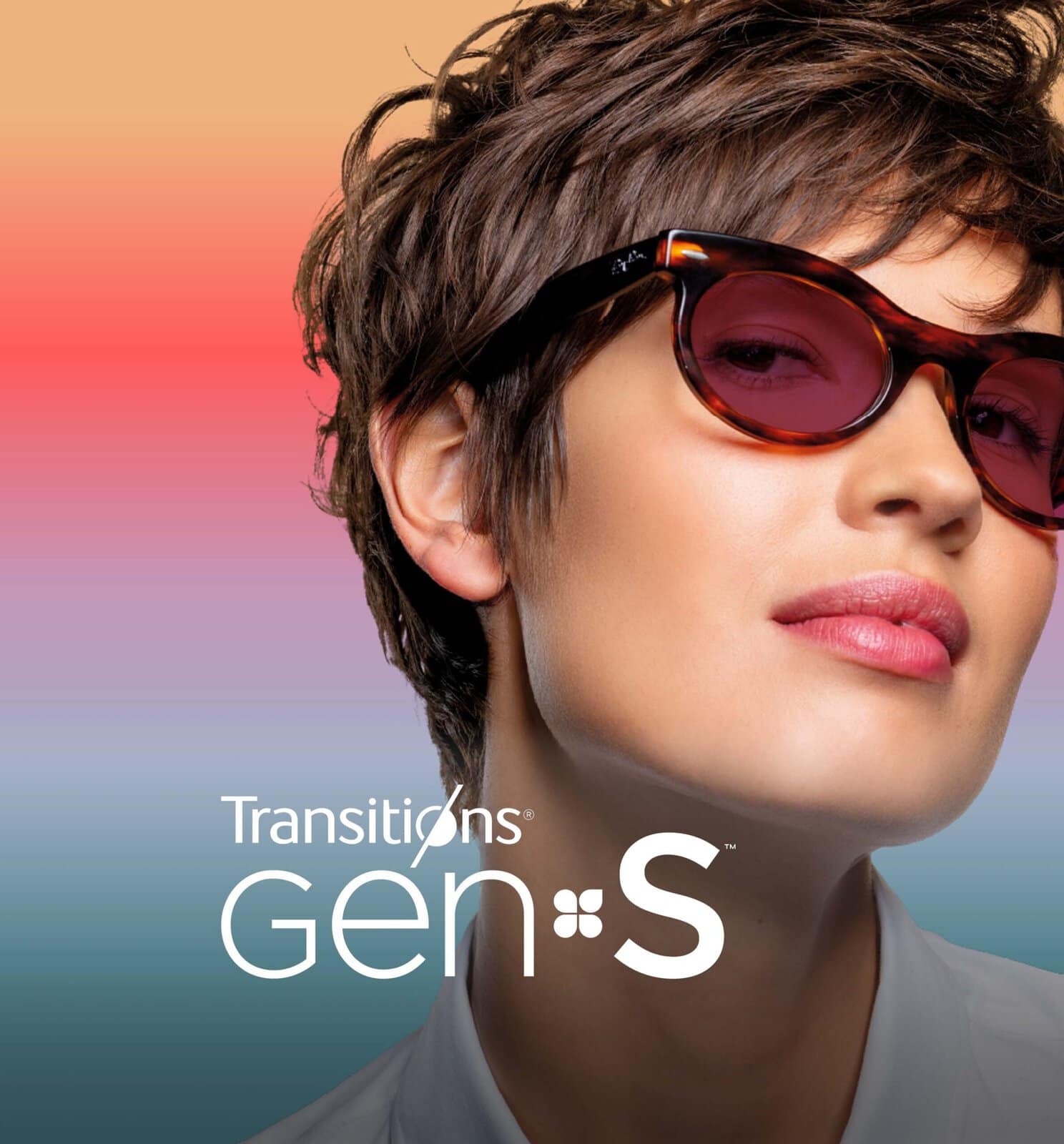
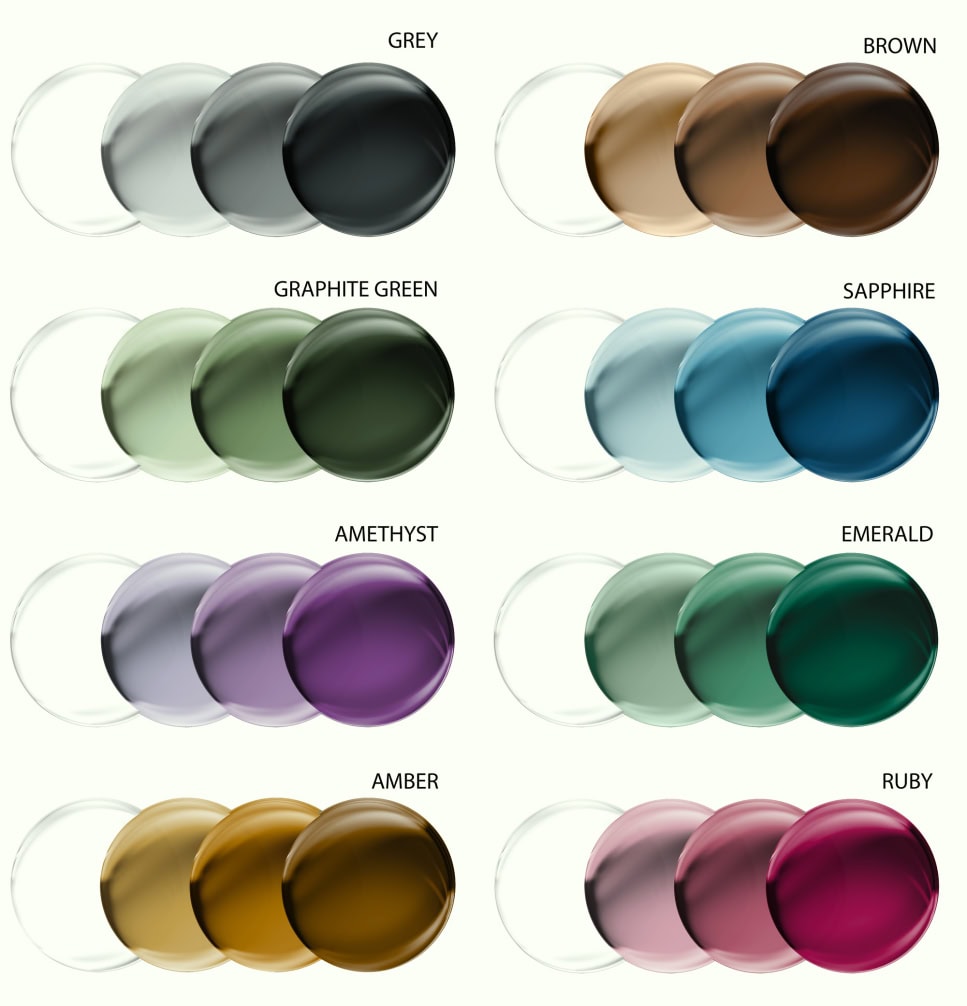
At Actons, you do not have to choose from a colour chart alone. We have a Transitions GEN S demonstration kit with a sample lens in every colour and a UV light, so you can watch the lenses darken and return to clear in the practice. This lets you compare the colours against your chosen frame and see the speed of the change for yourself before ordering.
Transitions XTRActive New Generation
Transitions XTRActive New Generation is designed for people who want extra darkness outdoors and some activation behind a car windscreen. Unlike most light-reactive lenses, it responds to visible light as well as ultraviolet light, allowing it to develop a noticeable tint in the car where standard photochromic lenses usually remain much lighter.
It can be a particularly good option for patients who are light-sensitive, spend a lot of time outdoors or want more glare reduction while driving. Its advantages include greater darkness outdoors, activation behind the windscreen and strong everyday protection from bright light.
There are some trade-offs. XTRActive keeps a slight tint indoors, so it does not look quite as clear as GEN S, and it can take longer to return fully towards clear. It is also available in fewer colours. Although it can darken in the car, it may not replace dedicated prescription sunglasses for every driver or every lighting condition.
At Actons, we can compare XTRActive with GEN S and help you decide which matters most for you: the clearest appearance indoors and fastest return to clear, or extra darkness and in-car activation.
Crizal Natural Look coating
Crizal Natural Look is Essilor’s current premium anti-reflection coating and has replaced the now-discontinued Crizal Sapphire HR. If you have previously worn or asked for Sapphire HR, Natural Look is its successor rather than an additional coating alongside it.
It combines the same advanced level of scratch resistance as Sapphire HR with protection against smudges, dust, water and back-surface UV, while adding Advanced Aesthetic Technology to make the coating itself much less noticeable. The key improvement is appearance: Natural Look is designed to reduce both the intensity and the residual colour of reflections, giving a more neutral, discreet appearance and allowing the wearer’s eyes to remain more visible through the lenses.
Natural Look also retains Essilor’s two-year scratch guarantee, an important reassurance with a premium coating. Essilor specifically recommends Natural Look with Transitions lenses because the reduced residual coating colour helps the Transitions tint look more natural through the different stages of activation.
No coating makes a lens indestructible, so suitable cleaning and storage remain important. Every pair includes a cleaning cloth and solution, and you can bring the bottle back for unlimited free refills.
Looking After Your Glasses
Every pair includes a cloth and cleaning solution. Bring the bottle back for unlimited free refills, and visit whenever you need free adjustments.
Re-using Existing Frames
We can often fit new lenses into a frame you already enjoy wearing, provided it is in suitable condition. Because older frames can sometimes weaken or break during reglazing, we will inspect the frame first and explain the small risk before proceeding. You can also browse our current glasses frames if you would prefer a new frame.
Frequently Asked Questions
Do I need new glasses if my prescription has only changed a little?
Not necessarily. We will explain how much your prescription has changed and what difference you are likely to notice, then leave the decision with you.
Can you help if I have struggled with varifocals before?
Yes. We can look at the lens design, measurements, prescription, frame fit and how you use your glasses to see whether a different approach may work better.
What are occupational or computer lenses?
They are designed for close and intermediate distances, such as reading, desk work and multiple screens. They can provide a wider comfortable working area than general varifocals for these tasks.
Do you offer specialist lenses for children?
Yes. Options include Eyezen Kids enhanced single-vision lenses and durable Crizal Kids coatings. We will recommend the most suitable combination for your child’s age, prescription, frame and activities.
Can stronger prescriptions be made with thinner lenses?
In many cases, yes. We will compare the likely benefit and cost of different lens materials for your prescription. Frame size, shape and fit can also make a substantial difference, and a well-chosen frame may reduce the need to pay for the highest-index lens.
What is the difference between Eyezen Start and Eyezen Boost?
Eyezen Start is an enhanced everyday single-vision lens designed to provide clearer, more comfortable vision across the lens. Eyezen Boost also includes gentle support for prolonged close work and screen use, making it more suitable for some people with visually demanding digital lifestyles.
Do I need an anti-reflection coating?
It is not essential for everyone, but many patients find it improves clarity, reduces reflections and makes lenses easier to keep clean. We will explain the options and costs.
Are the latest Transitions lenses better than older light-reactive lenses?
Yes. Transitions GEN S is designed to darken faster, return to clear more quickly and provide a wider choice of colours than many older photochromic lenses. Patients who disliked an earlier generation may find the latest technology performs very differently.
Can I see the Transitions colours before choosing?
Yes. We have a demonstration lens in every GEN S colour and a UV light, so you can compare the colours with your chosen frame and watch the lenses darken and return towards clear before ordering.
Do Transitions lenses work in the car?
Standard GEN S lenses usually remain lighter behind a windscreen because much of the ultraviolet light is filtered out. Transitions XTRActive responds to visible light as well as UV, so it can develop a noticeable tint in the car, although dedicated prescription sunglasses may still be preferable in some conditions.
What is Crizal Natural Look?
Crizal Natural Look is Essilor’s premium anti-reflection coating and has replaced the now-discontinued Sapphire HR. It keeps the same advanced level of scratch resistance, retains the two-year scratch guarantee and makes residual reflections and their colour much less noticeable, so the lenses look clearer and more natural on the face.
Can I come back if my glasses need adjusting?
Yes. You are welcome to return whenever your glasses need a fit adjustment, whether they are new, have become loose or no longer sit quite straight.
How do the free cleaning-solution refills work?
Simply bring your empty bottle back into the practice and we will refill it free of charge.
Can you fit new lenses into my existing frame?
Often, yes. We will inspect the frame first and let you know whether it is suitable for reglazing.
Would you like advice about your lens options?
Contact Actons Opticians to arrange an appointment or ask about the most suitable lenses for your needs.