Colour blindness is a familiar term, but colour vision deficiency is usually more accurate. Most people with a colour vision deficiency can see colour; they simply see some colours differently or find particular shades harder to tell apart.
It is common, especially in men, and many people do not realise they have it until they are tested. For children, early recognition can be helpful because colour is used so often at school, from maps and charts to colouring, science and sports.
What are the main types of colour blindness?
Normal colour vision depends on three types of cone cells in the retina that are most sensitive to different parts of the visible spectrum. Colour vision deficiency happens when one cone system does not work in the usual way or is absent.
Red–green colour vision deficiency
This is by far the most common form. There are two main groups:
- Protan defects affect the red-sensitive cone system. Reds may appear darker and it can be difficult to distinguish some reds, greens, browns and similar shades.
- Deutan defects affect the green-sensitive cone system. This is the most common inherited colour vision deficiency and can cause difficulty separating greens, reds, browns and oranges.
Within each group there are milder forms, where the cone system works differently, and more marked forms, where one cone system is effectively absent.
Blue–yellow colour vision deficiency
Blue–yellow, or tritan, defects are much less common. They can make some blues and greens, or yellows and pinks, harder to distinguish. Unlike the common inherited red–green defects, tritan deficiencies are not usually linked to the X chromosome.
Complete colour vision loss
Very rarely, a person may have extremely limited or absent colour discrimination. This is quite different from the much more common red–green deficiency and may be associated with other visual symptoms.
Why is colour blindness much more common in men?
The answer lies in genetics.
The genes responsible for the common red–green colour vision deficiencies are carried on the X chromosome. Men usually have one X chromosome and one Y chromosome, while women usually have two X chromosomes.
A man therefore has only one copy of the relevant X-linked colour-vision genes. If that copy carries a change that causes red–green colour vision deficiency, there is no second X chromosome to provide a normal copy.
A woman has two X chromosomes, so if only one carries the altered gene, the other often provides a normally functioning copy. She may therefore be a carrier without having a significant colour vision deficiency herself. For a woman to inherit a typical red–green deficiency, she generally needs the relevant altered gene on both X chromosomes, which is much less likely.
This is why inherited red–green colour vision deficiency affects roughly 1 in 12 men but only a small proportion of women.
The inheritance pattern also explains some family patterns. A father does not pass his X chromosome to his sons, so an affected father cannot directly pass an X-linked red–green deficiency to a son. A mother who carries the altered gene can pass it to her sons or daughters.
Can colour blindness develop later in life?
Yes. Not every colour vision problem is inherited.
Colour vision can sometimes change because of eye disease, certain neurological or medical conditions, eye or head injury, or some medicines. If an adult notices a new or worsening change in colour perception, particularly if it affects one eye more than the other, it is worth arranging an eye examination rather than assuming it is a lifelong inherited trait.
What signs might parents notice in children?
Children with colour vision deficiency usually see perfectly well in every other respect, so the problem can be easy to miss.
Possible clues include:
- regularly using unexpected colours when drawing or colouring
- difficulty sorting objects by colour
- confusing colours such as red and green, green and brown, blue and purple, or pink and grey
- needing to ask other people what colour something is
- struggling with colour-coded school work, maps, charts or computer displays
- being reluctant or frustrated during colouring activities despite otherwise good vision
None of these signs proves that a child has colour vision deficiency, but they are a good reason to ask about testing. Our Children’s Eyecare page explains more about eye examinations for children at Actons.
How does an optician test colour vision?
The best-known colour vision test is the Ishihara test. It uses a series of plates made up of coloured dots. Numbers or patterns are hidden within the dots using carefully chosen colour combinations.
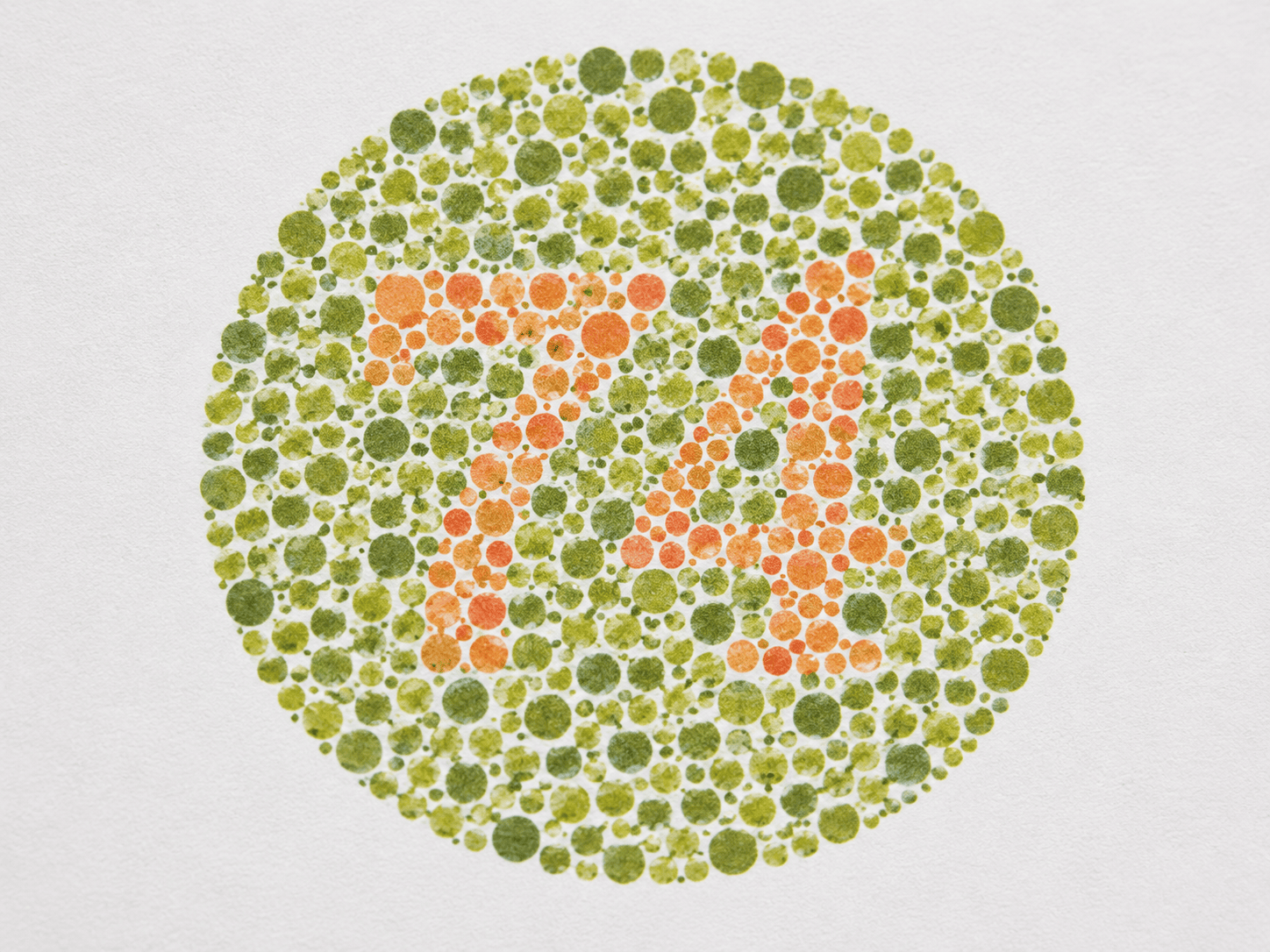
Someone with normal red–green colour vision will see one number or pattern, while a person with a particular colour vision deficiency may see a different one or may not see the figure at all.
Other tests can ask the patient to arrange coloured caps or tiles in order by hue. These can provide more information about the type and severity of a colour vision defect.
Colour vision testing is not automatically part of every routine NHS sight test, but it can be carried out when relevant or when there is a particular concern. The College of Optometrists advises that colour vision should be screened in children where appropriate.
Are online colour blindness tests reliable?
They can be interesting as a rough screening exercise, but they have limitations. Screen brightness, colour calibration, display technology and room lighting can all change how the colours appear.
If a result matters for a child’s education, a career choice or simply because you are concerned about a change in colour perception, a proper test under controlled conditions is more useful.
What does colour blindness mean in everyday life?
For most people it is an inconvenience rather than a disability that prevents normal daily life. People often develop their own strategies without consciously thinking about them.
Situations that can be awkward include:
- reading maps, graphs or charts that rely only on colour
- matching clothes
- identifying ripeness or changes in colour in food
- distinguishing coloured wires, indicator lights or warning systems
- interpreting colour-coded medication, laboratory or workplace information
- some computer games, apps and websites that use colour alone to convey information
Traffic lights are usually manageable because people also learn their position and brightness, and in the UK ordinary colour blindness does not need to be reported to the DVLA. People with colour vision deficiency can normally hold a car or motorcycle licence provided they meet the other eyesight standards.
How can schools help a child with colour vision deficiency?
Once a school knows, small changes can make a significant difference. Teachers can avoid relying on colour alone, add labels to coloured diagrams, use patterns as well as colours on graphs, and check that a child can distinguish pens, pencils and teaching materials.
This matters because an undiagnosed child may appear to have misunderstood a task when the real problem is simply that two colours look almost identical to them.
Can colour blindness affect career choices?
Yes, but the effect depends on the type and severity of the colour vision deficiency and the exact standards for the job.
Many careers have no colour-vision restriction at all. However, some safety-critical occupations require reliable colour discrimination because coloured signals, warning lights, maps, wiring or displays are part of the job.
Examples can include:
- commercial aviation – UK pilots are assessed for colour vision. The initial medical includes Ishihara testing, with further specialist testing available in some cases if the screening test is not passed
- railway driving and some rail safety roles – colour vision may be important because of coloured signalling and safety information
- some maritime, military and emergency-service roles – standards vary according to the duties involved
- some technical roles where accurate identification of coloured wiring, signals or warning indicators is safety-critical
A colour vision deficiency does not automatically rule someone out of an entire industry. Different roles can have different standards, and some organisations use more detailed testing to decide whether a person is sufficiently colour-safe for a particular task.
If a young person is considering a career with a known colour-vision requirement, it is sensible to check the current occupational standard before committing to expensive training. The UK Civil Aviation Authority, for example, specifically advises prospective pilots to check their medical eligibility before investing heavily in flight training.
Can colour blindness be treated?
There is currently no treatment that restores normal colour vision in the common inherited forms.
Some tinted lenses and filters can change the contrast between colours and may help with particular tasks, but they do not create normal colour vision and should not be regarded as a cure. They may also be unsuitable for occupational colour-vision testing.
If colour vision has changed because of an acquired eye or medical condition, treatment of the underlying cause may sometimes help.
When should you ask for a colour vision test?
It is worth asking if:
- your child repeatedly confuses colours or struggles with colour-coded work
- there is a family history of colour vision deficiency
- a teenager is considering a career with colour-vision standards
- you notice a new change in your own colour perception
If you have concerns about your own or your child’s colour vision, mention them when arranging an appointment. We can advise whether colour vision testing is appropriate alongside the wider eye examination.
Back to Eyecare for more related services and eye health advice.