Varifocal glasses let you see clearly at distance, at arm’s length and close up through one pair of lenses. But how can one lens contain so many different powers, and why do the edges sometimes feel less clear?
Varifocal lenses, also called progressive lenses, are one of the cleverest pieces of everyday optics. They do not contain three separate prescriptions divided by visible lines. Instead, the optical power changes continuously across the lens, creating a smooth progression from distance vision at the top to reading vision lower down.
The basic idea is simple. The design and fitting are not. A successful pair depends on the prescription, the lens design, the frame, accurate measurements and how the spectacles sit on the wearer’s face.
Why do people need varifocals?
When we are young, the natural lens inside the eye can change shape to focus from far away to close up. This focusing process is called accommodation. With age, the lens gradually becomes less flexible, so the eyes need more help to focus on reading and other near tasks. This normal change is called presbyopia.
At first, you may notice that small print is easier when held further away, or that reading is more tiring in poor light. Reading glasses can solve the near-vision problem, but they blur distance vision. Bifocals combine distance and reading powers, although there is a visible line and a sudden jump between them. Varifocals provide a continuous range of powers without a line.
How does the power change across the lens?
The top part of a typical varifocal lens contains the distance prescription. Moving down the lens, the power gradually changes through the intermediate zone until it reaches the full reading addition near the bottom.
A useful analogy is a gentle ramp rather than a staircase. A bifocal is like stepping from one level to another. A varifocal is more like walking down a slope, with the power changing a little at every point.
Image 1 illustrates this basic layout, showing how the lens changes from distance vision at the top, through the intermediate area, to near vision lower down.
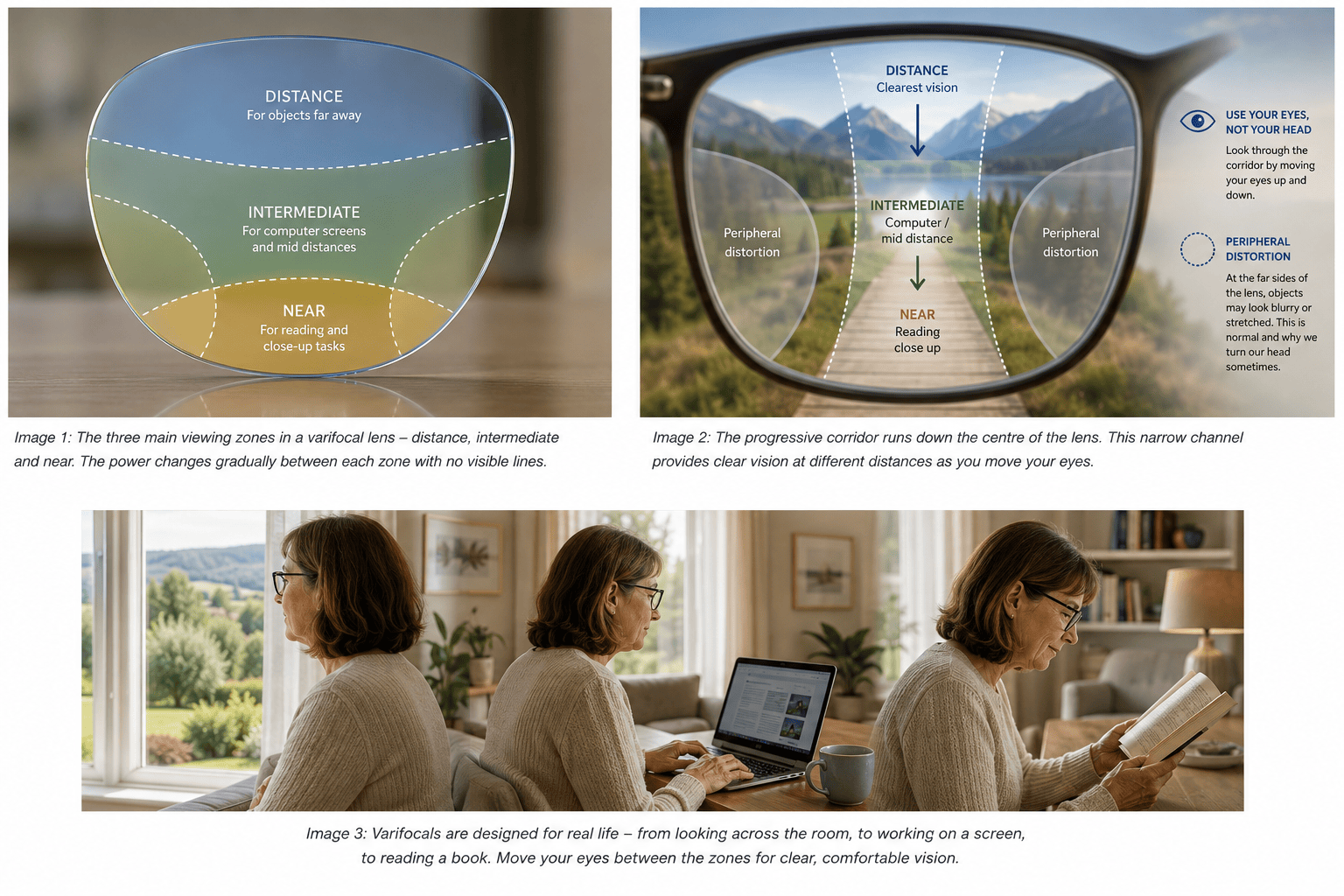
The three main viewing zones
| Viewing zone | Where it sits and what it is used for |
|---|---|
| Distance | Usually in the upper part of the lens. Used for driving, television, walking and seeing across a room. |
| Intermediate | Usually through the central progression area. Used for computer screens, dashboards, cooking and many tasks at arm’s length. |
| Near | Usually lower in the lens. Used for reading, phones, labels and other close work. |
There are not hard boundaries between these areas. Every point along the progression provides a slightly different focusing distance. That is why a well-fitted varifocal can provide clear vision across a wide range rather than at only three fixed distances.
What is the varifocal corridor?
The corridor is the central channel through which the lens power progresses from distance to near. When you look straight ahead through the upper lens, you use the distance zone. Lowering your eyes brings the intermediate and near areas into use.
The corridor is not necessarily a narrow strip that is identical in every lens. Its length, width and the way power changes through it depend on the prescription, frame depth and lens design. Some designs prioritise a wider distance area, some a broader intermediate area, and others a generous reading zone.
This is one reason why two varifocal lenses with the same prescription can feel quite different. The distribution of clear vision and peripheral blur may not be the same.
Image 2 shows this more clearly: the useful central corridor is surrounded by areas of peripheral distortion, which is why head and eye position can make such a difference.
Why is there blur at the sides?
A progressive change in lens power cannot be created without producing unwanted optical effects elsewhere on the lens. In simple terms, the design concentrates useful distance, intermediate and near vision through the central areas, while unwanted astigmatism is moved towards the sides.
This can create peripheral blur or a slight swimming sensation when the head moves. It does not mean the lens has been made badly. It is an unavoidable part of progressive-lens optics. The skill lies in controlling where that blur sits, how strongly it is felt and how smoothly the wearer moves between the clear and less-clear areas.
Modern freeform lens design allows the surface to be calculated very precisely. Better designs can often provide wider usable zones, smoother transitions and less intrusive peripheral distortion, but no genuine varifocal can be perfectly sharp across the whole lens at every viewing distance.
Why do premium varifocals often feel easier?
The difference is not simply the brand name. More advanced lenses may use more sophisticated calculations and more detailed measurements to distribute the optical compromises more effectively.
- wider or better-positioned viewing zones
- smoother changes in power
- better control of peripheral blur
- designs tailored to particular visual priorities
- greater use of individual frame and facial measurements
A person who spends much of the day driving may value a generous distance and intermediate area. Someone who works across several screens may need a design that gives more comfortable intermediate vision. A keen reader may prefer a wider near zone. The most suitable lens is the one matched to the wearer’s real visual needs, rather than automatically the most expensive option.
Why accurate measurements matter
A varifocal lens only works properly when its optical zones are positioned in front of the eyes. Important measurements include the horizontal position of each pupil and the fitting height within the chosen frame. More personalised designs may also take account of how far the lenses sit from the eyes, the angle of the frame and the way it wraps around the face.
The frame itself matters too. It must have enough usable depth for the selected design and should sit securely without slipping. A technically excellent lens can perform poorly if the frame position is unstable or the fitting measurements are inaccurate.
This is why careful frame selection, dispensing and adjustment are part of the optical result rather than simply finishing touches.
How do you use varifocal glasses?
Most wearers quickly learn to point their nose roughly towards what they want to see and then use small eye movements to find the clearest part of the lens. For reading, the eyes look down through the near zone. For a computer screen, the chin may need to be raised or lowered slightly until the intermediate area lines up with the screen.
Image 3 brings this into everyday life, showing how different parts of the lens are used for different tasks and viewing distances.
Stairs and kerbs can initially feel unusual because looking down may bring the reading power into use. Turning the head slightly more, rather than trying to look far through the extreme edge of the lens, often helps during adaptation.
How long does adaptation take?
Some people feel comfortable immediately. Others need several days or occasionally longer. Wearing the new glasses consistently usually helps the visual system learn where the useful zones are. Constantly swapping back to an old pair can slow that process.
Persistent difficulty should not simply be accepted. The prescription, measurements, frame adjustment and lens design can all be reviewed. Sometimes a small frame adjustment makes a significant difference.
Can varifocals be used for computers?
Yes, but the screen must line up with the intermediate part of the lens. For ordinary mixed use, general-purpose varifocals often work well. For prolonged computer work, especially with large or multiple screens, an occupational or office lens may provide a wider intermediate area and a more natural head position.
The best solution depends on the screen distance, working posture and the range of other tasks involved. Our article on digital eye strain includes further practical advice for comfortable screen use.
Common questions about varifocals
| Question | Answer |
|---|---|
| Can I drive in varifocals? | Yes, provided your vision meets the legal standard and you are comfortable using the distance and intermediate zones. The dashboard is normally viewed through the intermediate area. |
| Do varifocals replace reading glasses? | For many people, yes. They provide distance, intermediate and near vision in one pair, although some wearers still prefer a separate pair for prolonged reading or specialist tasks. |
| Are varifocals the same as bifocals? | No. Bifocals have two distinct powers separated by a visible line. Varifocals change power continuously and also include intermediate vision. |
| Why can my friend wear varifocals easily when I struggled? | Prescriptions, reading additions, frame choices, visual habits and sensitivity to peripheral blur all vary. Lens design and fitting accuracy also make a substantial difference. |
| Are expensive varifocals always better? | More advanced designs can offer wider or smoother viewing zones, but the best choice depends on your needs, prescription, frame and budget. Accurate fitting remains essential at every level. |
The real secret of successful varifocals
Varifocals work by combining a continuous range of lens powers with carefully positioned viewing zones. The optical design matters, but so do the eye examination, prescription, frame choice, measurements, fitting and final adjustment.
At Actons Opticians, we take time to understand how you use your eyes throughout the day and to explain the options clearly. That allows us to recommend a lens design and frame combination that is appropriate for you, rather than treating every varifocal wearer in the same way.
Would you like to discuss varifocal glasses?
We can explain the lens options, help you choose a suitable frame and take the measurements needed for accurate fitting.